How QA closeout impacts your cashflow

In civil construction, the work on the ground often moves faster than the paperwork behind it. Crews complete the job, the site is ready to hand over, and everyone expects payment to follow, but the claim stalls because the QA documentation isn’t ready. The result is a familiar frustration: the work is done, but the cash hasn’t landed. Understanding why this happens (and how to fix it) starts with recognising how QA links directly to the payment chain.
Where payments delays start
More and more often civil contracts are requiring QA evidence before a claim can be submitted. If the QA pack isn't complete, you aren't guaranteed you'll be paid what you're owed.
There are three common bottlenecks:
- Closeout happens after the work: QA is treated as a final step, meaning the admin burden continues to build until the last possible moment
- Evidence is scattered: photos on phones, signatures on paper, updates buried in emails - now you're spending hours piecing together what actually happened, and tracking down proof of work.
- Approvals lag behind construction: Engineers and PMs end up chasing documentation, instead of confirming completion of work
Meanwhile, you've got areas of work that appear finished, but are stuck in financial limbo.
"More and more frequently… if we don't provide QA, we're not getting paid that following month."
Blair Williams, Viridian Glass
The cashflow effect
Recently, we've seen local government changing the model. To gain full visibility, councils are moving away from the old model of relying on contractor systems and are instead exploring the benefits of a single, unified QA platform.
By providing a tool like CONQA, councils ensure every contractor captures quality data in the same format, in real time, and flows it directly back to council. That shift gives you full visibility and control — not weeks later, but as the work happens.
Make the change: align QA alongside your work, not after it finishes
The contractors who get paid faster aren’t completing more paperwork, they’re changing when QA happens. Instead of treating QA as something to “catch up on” at the end, they capture evidence as the work is completed.
This turns QA into a natural part of delivery. Photos are taken while the crew is on site. Checklists are completed in the same moment the work is signed off. Hold points are recorded in real time, not reconstructed from memory later.
By closing out QA progressively, the documentation is already nearly complete when the physical work is finished. That means claims can be submitted sooner, approvals are smoother, and cashflow keeps pace with construction rather than lagging weeks behind it.
"Initially it would take around 3 months to complete a project handover, my goal is to have that reduced to 30-days. That's the target and the app is helping us achieve that. It makes it easy to close those Lots Reports and have separate ones. This is because the work is happening continuously throughout the project rather than leaving it to the end like a large back-log."
Whineray Arries, Quality Manager, Downer
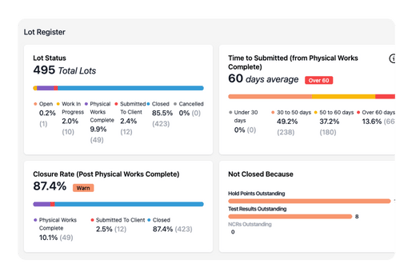
What this looks like in practice
- Crews complete checks on their phone while on site
- Hold points are visible and tracked, not remembered
- Evidence is linked directly to the area it applies to
- Project managers see progress at a glance, not after chasing updates
- Claims are lodged days, not months, after completion
This isn’t about creating more work, it’s about capturing the right evidence at the right time.
The bottom line? If QA falls behind, payment falls behind. When QA keeps page with construction, cashflow keeps pace too.
Progressive QA doesn't just help you stay audit ready, it puts money in the bank sooner.
Want to see what progressive QA looks like in action?
Book a demo and find out how clean, consistent QA closeout accelerates payment claims.