Infrastructure KPIs you should already be tracking

Why KPIs are non-negotiable in modern QA
On high-stakes infrastructure projects, you can't afford to guess about quality. To prove consistent delivery and protect your reputation, you need to move beyond gut feelings to a data-driven approach. By tracking the right quality assurance KPIs, you can provide objective proof of performance, align your site teams and clients with a shared goal, and have an early warning system for hidden risks before they cause costly delays.
Here are the 6 key KPIs every manager should have on their quality dashboard.
1. Lot status distribution
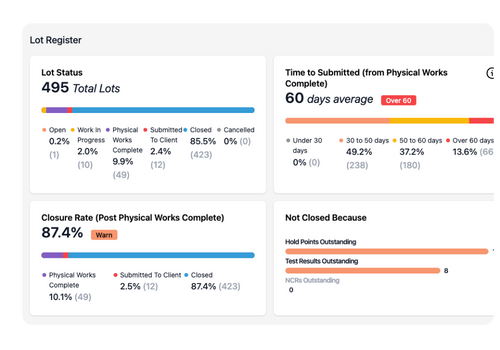
This is your project's pulse, showing a real-time breakdown of work lots by their current stage (e.g., In Progress, Submitted, Closed). Tracking Lot status is key to identify bottlenecks, and show if work is flowing smoothly from physical completion to final handover or if documentation is piling up and putting progress at risk.
2. Submission and Closure cycle times
As a core measure of efficiency, this KPI tracks the administrative drag on your project. It measures the average time from when physical work is finished to when documentation is submitted, and finally to when the lot is formally closed. Long cycle times represent massive hidden risks and tied-up cash flow sitting on the books.
3. NCR rate
Your NCR rate is the primary measure of first-time quality. Typically tracked as the number of NCRs per a set number of inspections, a rising rate acts as an early warning for systemic issues, whether it's a flawed methodology, poor-quality materials, or an underperforming subcontractor.
4. Closure rate
This metric shows the percentage of physically completed work that has been fully signed off and closed out. It’s a key indicator of your team's ability to finish what they start. A low closure rate is a clear warning that unresolved issues are accumulating, which can jeopardise milestone payments and final handover.
"With the help of CONQA, we can reduce manual paperwork, increase productivity and gain real-time insights throughout the build process"
Ajith Kulappurath, Regional Quality Manager, Fulton Hogan
5. Intervention point compliance
This is a crucial risk and compliance metric. It tracks the percentage of critical hold, witness, or intervention points that are signed off on time, before subsequent work proceeds. High compliance demonstrates strong process control, while a low rate can flag serious contractual and safety risks.
6. Rework percentage
Rework is a direct hit to your bottom line. This KPI tracks the percentage of work, measured in cost, hours, or volume, that requires correction or re-inspection. Monitoring it helps you quantify the true cost of quality failures and build a powerful business case for process improvements or subcontractor intervention.
How to capture and track these KPIs efficiently?
The days of tracking this on spreadsheets are over. It's inefficient, prone to errors, and the data is already out of date by the time you've compiled it.
To track these KPIs meaningfully, you need to digitise the source of the data: your on-site inspections and Lot management. A dedicated QA platform like CONQA allows you to:
- Automate data capture: Lot status changes, completion dates, and submission times are updated automatically as work happens in the field
- Standardise everything: Use consistent, templated inspection and test plans (ITPs) across all projects, ensuring you're always measuring apples to apples
- Link evidence to the source: Capture photos and sign-offs directly within the inspection, providing the context and irrefutable proof needed to close work out faster
Try it out yourself, and experience how CONQA automatically captures and visualises your QA KPIs, giving you real-time insight without the hassle.