
When a builder reports a defect weeks after install, a tick sheet can't show what left your factory. Here's how Kalos Windows & Doors started keeping that record, and what it found.
A builder rings two weeks after install. A frame is scratched, or a handle is loose, or a support bar never turned up. The unit left your factory a fortnight ago, and the question on the phone is simple: was it like that when it left you?
Most manufacturers can't answer that. The QA sheet says the unit was checked. It doesn't say what was checked, who checked it, or what condition it was in when it went on the truck. So the call-out goes ahead, someone loses a day to the return trip, and the fix is done at your cost whether the fault was yours or not.
The unit shipped and the record didn't
A paper tick sheet records that a check happened. It doesn't hold what the person saw. And a lot of what matters can't be looked at again once the unit is built. Sealant, fixings and anything else the frame closes over are gone from view by dispatch.
That turns rework into a record problem as much as a workmanship one. Without a record you can't tell which defects started in your factory and which started on site, so you fix all of them. You also can't see the pattern in the ones that really are yours, so the same faults keep coming back.
What Kalos found when it started keeping the record
When Kalos Windows & Doors changed ownership in September 2025, the new owners inherited more than 300 maintenance items. QA ran on a one- or two-page paper tick sheet. Co-owner Simon Hvalica estimates maintenance and rework were costing around $600,000 a year across labour, vehicles, materials and NCR accounts.
For Hayden Hunt, who runs the commercial factory, the last straw was a builder ringing about a loose handle:
"How did this even leave the factory with basically one screw on it?"
Hayden Hunt, commercial production manager, Kalos Windows & Doors
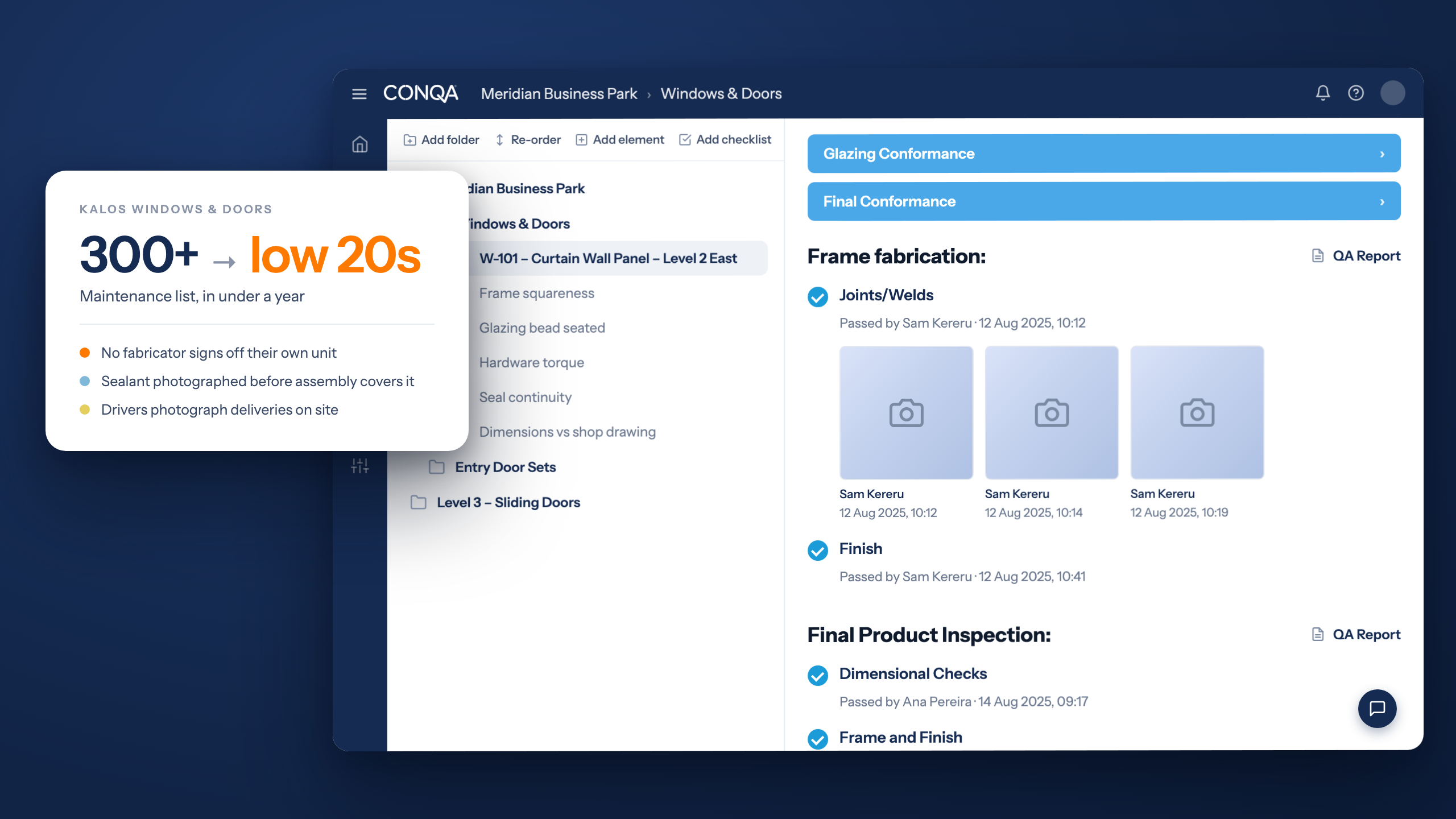
Kalos moved its QA into CONQA and had it running across all three factories by January 2026. The record is now made at the point of work:
- Cutting and prep teams photograph and sign off their own work.
- In fabrication, nobody signs off their own unit. Fabricators check each other's work, and the pairings rotate.
- Work that assembly will cover gets photographed while it's still visible. The bead of sealant is the standard example.
- Drivers photograph deliveries on site.
300+ → low 20s
The Kalos maintenance list, in under a year
Most of the issues happened after the joinery left the factory
Once the records built up, Kalos could see where its defects came from. Based on those records, it estimates about 80% of the issues happened after the joinery left the factory.
Before that, there was no evidence either way, so Kalos did most of that rework at no charge. Simon calls it doing fix-ups "for love."
Now, when a builder reports a scratched frame, the team goes back to the production and delivery photos and sees the condition the frame was in before it left their hands.
"We have evidence to back ourselves up, saying it wasn't like that when it left."
The same goes for missing parts. When a builder said a support bar had never arrived, Hayden sent the delivery photo back with one line: "It looks like it is in Bedroom three. Have you checked in there?" Replacement support bars had been a steady cost. Since drivers started photographing deliveries, Hayden says, that has almost completely died down.
The record decides what you choose to fix
Kalos still helps a good customer with something that isn't its responsibility. The difference is that it now chooses to, with the evidence in front of it.
The defects that really are its own get fixed faster too. Getting to a genuine defect used to take two to three weeks. Now it's the same week, and some are done the same day. Simon puts the reduction in rework-related costs at around 60%. Kalos went from two maintenance vehicles to one, and the role that fell vacant on the maintenance team was never replaced.
It shows up in the money as well. Builders had been holding back payment over defects still open on site. With the QA record behind the work, those conversations start from what was checked and what condition the product was in when it left.
"We're delivering a product on time, in full, with quality. People do not have a reason to pay late."
Simon Hvalica, co-owner, Kalos Windows & Doors
What the record has to hold
If the question is "was it like that when it left you?", the record has to answer it before anyone asks. From the Kalos rollout, that means:
- Made at the point of work. A photo of the sealant taken before the frame goes on, not a tick added at the end of the shift.
- Tied to the unit. Each check sits against the specific unit, so the evidence for one frame can be pulled up when that frame is questioned.
- Carried through dispatch and delivery. The last photo in the record is what the unit looked like on site, taken by your driver.
- Checked by someone other than the maker. Kalos rotates who checks whom, so the standard holds across the factory.
"We know the quality is there. Now we can prove it."
Simon Hvalica, co-owner, Kalos Windows & Doors
Read the full Kalos story →
See how CONQA works for windows and doors manufacturers →
Questions
How do you prove a window or door was undamaged when it left the factory?
Record its condition at the point of work and at dispatch, against that specific unit, and have drivers photograph the delivery on site. When a builder reports a scratched frame, Kalos Windows & Doors goes back to its production and delivery photos in CONQA and sees what the frame looked like before it left the factory.
Why do manufacturers end up paying to fix damage that happened on site?
Without a record of what the unit looked like when it left, there's no way to show where the damage happened, so the fix is usually done at the manufacturer's cost. Once Kalos started keeping that record, it estimated about 80% of its issues happened after the joinery left the factory. Before that, it did most of that rework at no charge.